
Yes, eBay to Amazon arbitrage still works in 2026, but only under three conditions: the item sells fast on Amazon, you've confirmed real demand at that ASIN before buying, and your margin after Amazon fees, shipping, and eBay's cut still clears a real profit. Run the fee math before you click "buy," not after.
TL;DR:
- Profitable eBay to Amazon arbitrage requires items to sell quickly on Amazon, with confirmed demand and after accounting for all fees and shipping costs.
- Tracking out-of-stock cycles on Amazon helps identify temporary price spikes, which can be exploited for quick profits from eBay listings.
- Using automated tools like profit dashboards, bulk checkers, and tracking alerts improves speed and accuracy when vetting deals at scale.
- Proper documentation, account monitoring, and adherence to brand and authenticity rules are essential to avoid Amazon suspensions.
- Focusing on proven sources, controlling inventory risks, and timing purchases around seasonal demand enhances long-term profitability.
Table of Contents
- What Is eBay to Amazon Arbitrage, and When Does It Work?
- How Do You Find and Flip Profitable eBay Items?
- What Tools Do Sourcers Use to Vet Deals Faster?
- How Do You Calculate Real Profit Before You Buy?
- How Do You Avoid Account Suspensions From Authenticity Complaints?
- How Do You Scale From Occasional Flips to a Real Pipeline?
- What Mistakes Cost New Flippers the Most Money?
- How Should You Handle Returns and Customer Complaints?
- How Do Arbitrage Sellers Stay Off Amazon's Radar?
- What Legal Issues Come Up When Reselling eBay Items on Amazon?
- How Does Seasonality Affect eBay to Amazon Flip Timing?
- What Separates Sellers Who Actually Profit From Those Who Don't?
- Scale Your Sourcing With a Real-Time Profit Dashboard
- Sources
What Is eBay to Amazon Arbitrage, and When Does It Work?
Retail arbitrage gets most of the attention in reselling circles, but eBay to Amazon arbitrage is its own distinct game, and it plays by different rules. The model is simple on paper: you find an item underpriced on eBay, confirm there's a matching, sellable listing on Amazon, buy it, and relist it at Amazon's higher price point. The profit sits in the gap between what eBay charges and what Amazon pays.
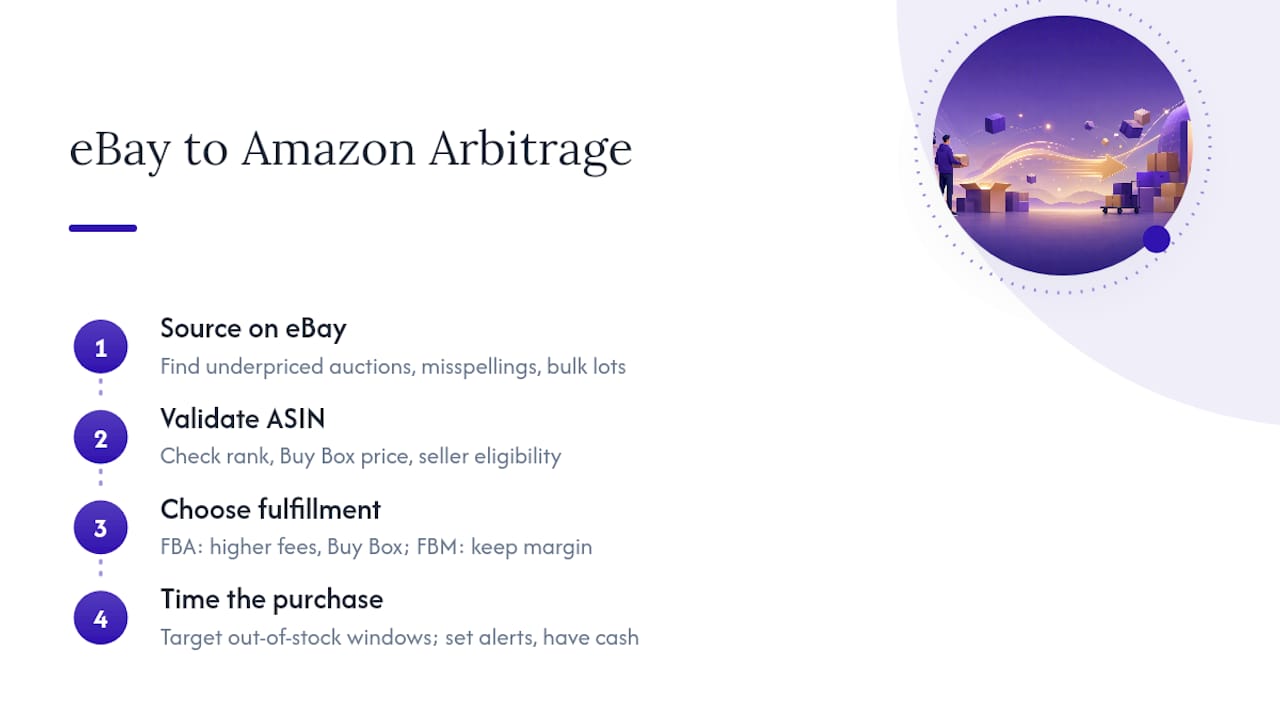
The mechanics break into four steps. First, you source on eBay, hunting for underpriced auctions, misspelled listings, or bulk lots that no one else is bidding on. Second, you validate the exact ASIN on Amazon, checking sales rank, current Buy Box price, and whether the listing is even available for third party sellers. Third, you decide fulfillment: Fulfillment by Amazon (FBA), where Amazon stores, picks, and ships the item, or Fulfillment by Merchant (FBM), where you ship it yourself. FBA costs more per unit but wins the Buy Box more often; FBM keeps more margin on slow movers or oversized items where Amazon's storage fees eat profit fast.
The real opportunity usually shows up during stock gaps. When a popular ASIN goes out of stock on Amazon, the price on that listing often spikes, sometimes for days, while the same item is still sitting on eBay at a normal price. Out-of-stock cycles on Amazon create temporary price windows that sharp sellers exploit by sourcing the identical SKU from eBay sellers who haven't noticed the shift. It's a sniper play. You need price history open, an alert set, and the cash ready to move within hours, not days.
Where does this beat retail arbitrage or wholesale? Retail arbitrage ties you to physical stores and their inventory limits. Wholesale requires upfront capital and supplier relationships before you see a single sale. eBay to Amazon flipping needs neither. You're working from a laptop, sourcing globally, and testing new categories with a single unit before committing real money. That flexibility is the entire appeal, and it's also why so many sellers underestimate how disciplined the sourcing rules need to be to keep it profitable.
How Do You Find and Flip Profitable eBay Items?
Sourcing without a system is how most new flippers lose money in their first month. Here's the sequence experienced resellers actually follow, in order:
- Search with intent, not curiosity. Filter eBay by "Buy It Now," ending soonest, and lowest price first. Target auctions with zero or one bid, listings with obvious misspellings (a "Nike Air Max" listed as "Nike Air Maxx" draws far less traffic), and liquidation or bulk lots where sellers price for volume rather than per-unit value.
- Pull the ASIN and check it against real Amazon data. Match the exact model, size, and variant. A near match isn't a match. If the ASIN doesn't exist yet, you'll need to create it, which usually isn't worth the time for a one-off flip.
- Check completed listings on eBay before you assume supply exists. Validating against completed listings tells you whether the item actually sells at that price consistently, or whether you just caught a one-time fluke.
- Run the Amazon sales rank and price history. A Best Sellers Rank in a strong sales rank for its category usually signals reliable turnover; very low sales rank signals a slow mover.
- Set your buy rules before you search, not after you find something tempting. Decide your maximum buy price, your minimum acceptable net margin (most experienced flippers won't touch anything under 20 to 25 percent after all fees), and your test quantity, typically one to three units on anything new.
- Buy the test batch, not the whole lot. Confirming a source is repeatable matters more than grabbing every unit on day one.
- Inspect condition immediately on arrival. Photograph any wear, missing accessories, or packaging damage before it goes anywhere near a box for Amazon.
- Route to prep correctly. If you're going FBA, follow Amazon's poly-bagging and labeling rules exactly. If FBM, ship from your own space and track transit times against your promised delivery window.
The pattern that separates profitable flippers from hobbyists isn't cleverness. It's repeating steps 1 through 5 dozen times a week until the good sources become obvious and the bad ones get filtered out automatically.
What Tools Do Sourcers Use to Vet Deals Faster?
Manual checking works for your first ten flips. Past that, it becomes the bottleneck that caps how much volume you can actually move.
Price-history trackers and out-of-stock monitors show you what a listing has actually sold for over weeks or months, not just what it's asking today. Without that history, you can't tell a genuine price gap from a seller who simply overpriced their own listing. Bulk checkers let you paste in dozens of ASINs at once instead of opening twenty browser tabs, and ROI calculators translate raw prices into actual take-home margin before you've spent a dollar. Watchlists close the loop by alerting you the moment a tracked ASIN's price or stock status shifts, which matters most during those short out-of-stock windows where speed decides who profits.
The tools that matter for a scaling reseller fall into a short list:
- Price and stock history trackers for spotting real out-of-stock windows
- Bulk ASIN checkers for vetting a lot's worth of items in minutes, not hours
- Net margin calculators that factor in FBA or FBM fees automatically
- Watchlist alerts that flag price drops or stock changes without you checking manually
- A verified supplier directory for sourcing beyond one-off eBay finds once a category proves itself
This is exactly the gap Resell Ready was built to close. Instead of juggling a spreadsheet, a calculator, and five browser tabs, you paste ASINs in and get instant buy or skip verdicts, an automated profit and loss dashboard that tracks capital tied up across every SKU, and a verified supplier database for when you're ready to move past one-off eBay finds into repeatable sourcing. If you're managing more than a handful of active flips at once, AI-assisted sourcing tools cut the research time dramatically.
Pro Tip: Set your watchlist alerts to trigger at a price threshold slightly above your target buy price, not exactly at it. Sellers often adjust prices in small increments, and a tight trigger means you'll miss the window entirely while waiting for the exact number.
How Do You Calculate Real Profit Before You Buy?
The number that matters isn't the price gap between eBay and Amazon. It's what's left after Amazon takes its cut, shipping eats into the margin, and your capital sits tied up in inventory for however long it takes to sell.
Amazon's fee structure has several moving parts. FBA charges a referral fee (typically 8 to 15 percent depending on category), plus fulfillment fees based on size and weight, plus monthly storage costs that climb during Q4. FBM skips fulfillment fees but adds your own shipping cost and time, and it typically wins the Buy Box less often than FBA listings. Amazon's own seller resources break down the current fee tiers, and running your specific ASIN through Amazon's fee calculator before buying is non-negotiable, not optional.
A quick template you can copy for every potential flip:
- eBay buy price + shipping to you = total cost
- Amazon sell price minus referral fee minus fulfillment fee (FBA) or your outbound shipping (FBM) = net revenue
- Net revenue minus total cost = net profit
- Net profit divided by total cost = margin percentage
Most experienced flippers set a floor around 20 to 25 percent net margin after every fee is accounted for, and they walk away from anything below that unless turnover is unusually fast. Blog guides covering online arbitrage math consistently flag the same trap: sellers calculate gross margin on the sticker price gap and skip the fee math entirely, then wonder why a "profitable" flip barely broke even.
Holding time matters just as much as the percentage. A 20 percent margin that sells in five days beats a 35 percent margin that sits for three months, because your capital is locked up and unavailable for the next flip the entire time it's sitting on a shelf.
How Do You Avoid Account Suspensions From Authenticity Complaints?
Amazon's biggest risk to arbitrage sellers isn't finding inventory. It's keeping the account that sells it.
Brand gating restricts certain categories and brands until you've proven you can source legitimately, usually by submitting an invoice from your supplier. When you're buying from individual eBay sellers rather than authorized distributors, that invoice often doesn't exist in a form Amazon accepts, which is why gated categories in electronics, beauty, and name-brand apparel trip up so many arbitrage sellers early.
Authenticity complaints happen when a buyer suspects an item isn't genuine, and Amazon takes these seriously enough to suspend listings first and ask questions later. Protect yourself by documenting condition thoroughly. Photograph the item, packaging, and any included accessories the moment it arrives, before it goes into prep. Keep your eBay purchase receipts and seller correspondence organized by SKU, not buried in your email.

If a claim comes in, respond fast with your documentation rather than waiting for Amazon to escalate. A quick, evidenced response often resolves the issue before it touches your account health metrics.
Watch your Order Defect Rate, cancellation rate, and late shipment rate weekly, not monthly. These metrics move faster than most new sellers expect, and a spike that goes unnoticed for three weeks is much harder to recover from than one caught in three days.
How Do You Scale From Occasional Flips to a Real Pipeline?
Moving from a handful of test buys to a repeatable business is where most arbitrage sellers either build something sustainable or run out of cash trying.
The flow that works: test buys first, one to three units, to confirm a source and margin are real. Once confirmed, route inventory through a prep center rather than doing it yourself, especially once you're moving more than a few dozen units a week. Prep centers receive shipments from your eBay sourcing, handle labeling and poly-bagging to FBA standards, and forward directly to Amazon's fulfillment network, which frees your time for sourcing instead of taping boxes.
Working capital planning matters more here than in almost any other reselling model, because you're spending cash today on inventory that might not sell for two to six weeks. A rough rule that keeps flippers solvent: never commit more than a third of your available capital to untested SKUs at once, and reserve the rest for restocking proven winners. Wholesale and inventory management guides covering Amazon sellers generally recommend targeting inventory turnover of six to twelve times per year, and that benchmark holds for arbitrage flippers too. Slower turnover means your cash is locked up longer than the margin justifies.
The automation trigger to watch for is repeatability, not volume. When the same eBay seller or the same category has produced three or more profitable flips in a row, that's the signal to scale buy quantity, not before.
What Mistakes Cost New Flippers the Most Money?
The mistakes that sink new flippers show up in a predictable pattern, and practitioner accounts of eBay to Amazon flipping point to the same three culprits every time.
- Trying to get ungated in every restricted category at once instead of proving out one category first.
- Buying long-tail, slow-moving items because the margin looks great on paper, ignoring that a 40 percent margin means nothing if the item takes four months to sell.
- Skipping the fee calculation and running on gut feel about what "should" be profitable.
A 30/60/90 day plan keeps things sane. In the first 30 days, run five to ten test flips on replenishable items you can reorder, not one-off finds. In days 31 to 60, identify which two or three sources produced consistent profit and start scaling quantity there. By day 90, you should have a short list of proven "replens," a repeatable buy rule, and a real sense of your average margin across dozens of completed flips rather than a handful of lucky ones.
Pro Tip: Keep a simple log of every flip, including the ones that lost money. The losing flips teach you more about which sourcing signals to avoid than the winners ever will.
How Should You Handle Returns and Customer Complaints?
Returns hit differently in arbitrage than in wholesale, because you can't always go back to the same eBay seller for a replacement or refund once your listing on Amazon is live.
Build return costs into your margin calculation from the start, not as an afterthought. FBA handles most return logistics automatically, but you still eat the cost of a returned item that can no longer be resold as new, so factor a small buffer, often 3 to 5 percent of expected revenue, into your minimum margin threshold for categories prone to returns, like apparel and electronics.
When a customer complaint arrives, respond within Amazon's required window every time. Late responses hurt your account health metrics even when the complaint itself gets resolved fine. For condition disputes, your prep photos become your defense. If a buyer claims an item arrived damaged or different from the listing, having timestamped photos from before it shipped settles most disputes in your favor quickly.
For genuinely defective items sourced from eBay, don't relist the replacement blind. Go back and re-verify the source listing's condition claims before assuming the eBay seller misrepresented the item versus something happening in transit or during prep. Sometimes the fault sits with your own handling, and pretending otherwise just sets you up to repeat the mistake with the next batch from that source.
How Do Arbitrage Sellers Stay Off Amazon's Radar?
Suspension risk for arbitrage sellers concentrates around a few specific triggers, and knowing them lets you build habits that avoid tripping any of them.
Invoice requests are the most common flashpoint. Amazon periodically asks sellers in gated or high-complaint categories to prove authenticity with supplier invoices. Since eBay purchases rarely come with a formal invoice, keep detailed records anyway: seller name, item description, price paid, date, and any correspondence. It won't always satisfy Amazon's request, but it demonstrates good faith and can support an appeal.
Inconsistent listing quality is a quieter trigger. If your photos, titles, or condition descriptions vary wildly in quality from batch to batch, it reads as unprofessional at best and suspicious at worst to Amazon's automated systems. Keep your prep and listing process standardized regardless of where the item came from.
Rapid category jumping raises flags too. An account that suddenly starts listing in five new categories within a week looks different from one that expands steadily. Grow into new categories deliberately, and let your track record in one area build before jumping to the next.
Finally, monitor your account health dashboard weekly, and never let a metric drift for more than a few days before addressing it. Sellers who check monthly are usually the ones surprised by a suspension notice; sellers who check weekly catch the drift and fix it before Amazon does.
What Legal Issues Come Up When Reselling eBay Items on Amazon?
Buying a product legally on eBay and reselling it on Amazon is generally allowed under the first sale doctrine, which permits reselling a legitimately purchased item regardless of what the original manufacturer's distribution agreements say. That said, the doctrine covers genuine, legally sourced goods, not counterfeits, and Amazon's own policies go further than the bare legal minimum in several areas worth knowing.
Brand-specific restrictions matter more than most new sellers expect. Some brands prohibit third-party resale entirely in their own terms with authorized retailers, and while that's a contract issue between the brand and its official distributors rather than a law you're breaking, Amazon can still gate or remove your listing if a brand files a complaint, regardless of how you sourced the item.
Trademark and counterfeit concerns sit separately from the first sale doctrine. Reselling a genuine item is legal; reselling something falsely represented as genuine is not, and that liability falls on you as the seller regardless of what the eBay listing claimed. This is exactly why authenticity documentation matters as much for legal protection as it does for account health
Sales tax obligations vary by state and by whether you're using FBA, since inventory stored in Amazon's warehouses can create tax nexus in states where you have no other physical presence. This gets complex fast, and it's worth a conversation with an accountant familiar with e-commerce once your volume grows past casual side income.
How Does Seasonality Affect eBay to Amazon Flip Timing?
Timing a flip around seasonal demand can turn a mediocre margin into a strong one, or turn a good margin into a loss if you buy at the wrong point in the cycle.
Holiday categories, toys, electronics, and home goods especially, see Amazon prices climb from October through December as consumer demand peaks and competing sellers' stock thins out. The smart play is sourcing these categories on eBay during the off-season, July through September typically, when sellers are clearing inventory and prices sit lower, then holding for the Q4 price climb. The tradeoff is storage cost if you're using FBA, since Amazon's storage fees increase during Q4 specifically, so the math needs to account for that added expense against the price gain.
Seasonal categories cut the other way too. Summer sporting goods and outdoor gear often see eBay sellers dumping off-season stock in September and October at steep discounts, right as Amazon demand for the same items is falling. That's a pattern worth avoiding rather than chasing, since you'd be buying into declining demand.
Back-to-school timing, roughly July through early September, creates a shorter but reliable window for electronics accessories, backpacks, and school supplies. The window is narrow, typically four to six weeks, so this works better for sellers who've already validated a source and can move fast rather than as a category to research from scratch each year.
What Separates Sellers Who Actually Profit From Those Who Don't?
The flippers who make real money treat this like inventory management with a research problem attached, not a treasure hunt. They check the same handful of signals on every deal, they walk away from anything that doesn't clear their margin floor, and they track results well enough to know which sources are actually working after thirty days instead of guessing.
What gets underestimated most is how much time manual research burns once you're past a dozen flips a week. The math on any single item takes two minutes. The math on sixty items a week takes hours, and those hours are exactly why dashboards that bundle ASIN checks, profit tracking, and supplier data into one place have become standard for anyone serious about scaling rather than dabbling.
The conventional advice to "just find good deals" skips the harder truth: good deals are everywhere on eBay. The skill is knowing within thirty seconds whether a deal is actually good after fees, shipping, and holding time, and having the discipline to pass on the ones that aren't.
— Christian
Scale Your Sourcing With a Real-Time Profit Dashboard
Manual spreadsheets get you through your first few dozen flips. Past that, Resell Ready is the upgrade that lets you check ten deals in the time a spreadsheet takes to check one. Paste ASINs in bulk and get instant buy or skip verdicts with suggested pricing, track net profit and capital tied up across every active flip with an automated P&L, and pull from a verified supplier database when you're ready to move beyond one-off eBay sourcing.

If you're moving bulk lots or liquidation pallets into your sourcing mix, the pallet liquidation ROI estimator runs the margin math before you commit to a lot. For sellers ready to see the full dashboard in action, start with Resell Ready and run your next batch of ASINs through it before your next buying session.
Sources
- Fulfillment by Amazon — Amazon Seller Services
- Arbitrage opportunities between Amazon and eBay: Leveraging out-of-stock gaps — Francesca Tabor
- How I'm making money on Amazon by flipping items from eBay (And how you can too) — Raiken Profit
- eBay to Amazon Arbitrage: How to Profit from Online Market Gaps — ZIK Analytics