
An AI pricing strategy is the practice of using machine learning and real-time data to set and adjust prices automatically based on demand, competition, and cost signals. For e-commerce sellers, this is no longer optional. Markets shift by the hour, compute costs fluctuate, and static price lists leave money on the table. The leading approaches in 2026 are hybrid pricing and dynamic pricing AI, both of which outperform manual methods on margin and speed. This guide walks you through the models, the math, the deployment steps, and the mistakes that quietly destroy profitability.
What AI pricing models work best for e-commerce sellers?
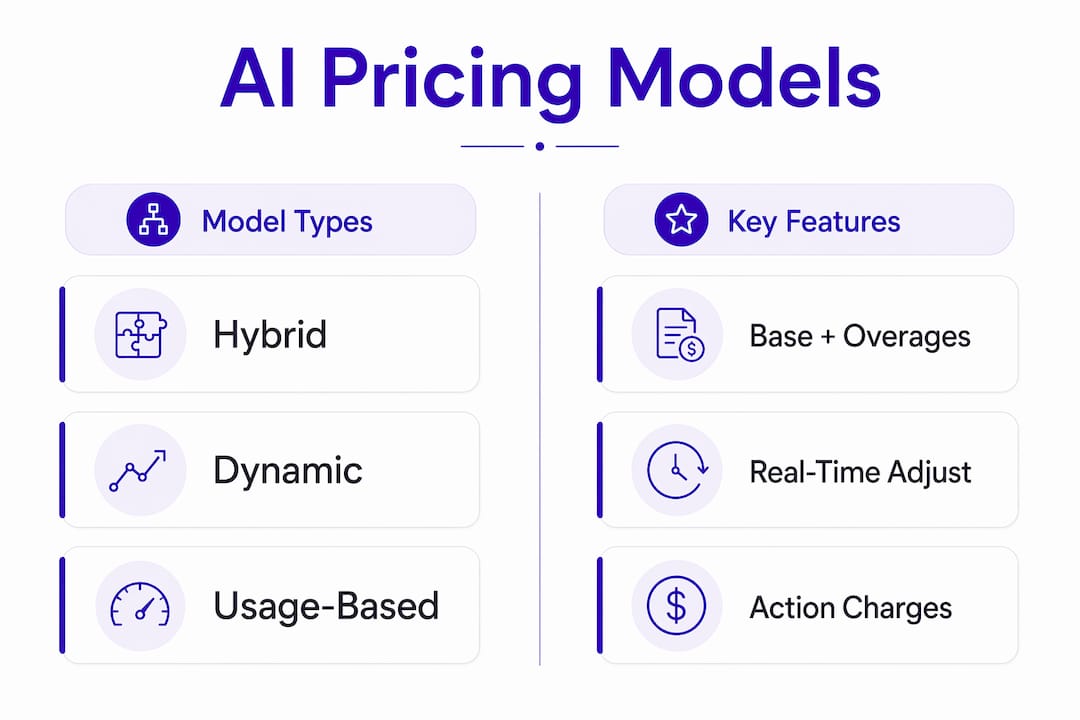
The four AI pricing models that matter most in 2026 are hybrid pricing, dynamic pricing, usage-based pricing, and outcome-based pricing. Each fits a different business structure, and choosing the wrong one costs real margin.
Hybrid pricing combines a flat base fee with usage-based overages. It is the current industry standard: hybrid model adoption rose to 41% over the past 12 months, while traditional per-seat pricing fell to 15%. That shift reflects a hard lesson. Per-seat models made sense for static software, but AI features carry variable compute costs that flat fees cannot absorb without margin damage.

Dynamic pricing AI adjusts prices in real time based on demand signals, competitor behavior, and inventory levels. When implemented with guardrails, dynamic pricing increases profit margins by 2%–5%. The guardrails matter. Without price floors and ceilings, automated systems can race to the bottom or trigger customer backlash.
Outcome-based pricing ties payment to a measurable result, such as a sale completed or a lead converted. This model works well when the AI's contribution to revenue is clear and trackable. It is harder to implement but builds strong customer trust because the seller only pays when value is delivered.
Usage-based pricing charges by the action, token, or API call. It scales naturally with volume but creates revenue volatility. Pure usage-based models generate unpredictable revenue swings, while pure flat models erode margins from heavy users. That is exactly why hybrid wins.
| Model | Best for | Key risk |
|---|---|---|
| Hybrid (base + overage) | Most e-commerce AI tools | Overage caps set too high |
| Dynamic pricing | High-volume, competitive SKUs | No guardrails causing price spirals |
| Outcome-based | Performance-linked AI features | Hard to attribute causation |
| Usage-based | API-heavy or data-intensive tools | Revenue volatility month to month |
Pro Tip: Avoid per-seat pricing for any AI feature with variable compute costs. A single heavy user on a flat seat license can consume 10x the compute of an average user, wiping out the margin on five other accounts.
How do you calculate AI costs and set profitable prices?
Margin math for AI-driven pricing starts with the per-action compute cost. Calculate what each AI call, recommendation, or repricing event costs in tokens or compute time. Then add a 30% variance buffer. Compute costs fluctuate with model updates, traffic spikes, and provider pricing changes. Building that buffer in from day one prevents margin surprises.
Two usage metrics define your pricing floor: P50 and P90. P50 is your median user, the person who uses the product at a normal rate. P90 is your heavy user, the top 10% by consumption. Failing to model P90 usage can destroy margins when unlimited flat-fee pricing is offered. A seller who reprices 500 SKUs daily costs you far more to serve than one repricing 20, yet both pay the same flat fee.
AI SaaS providers in 2026 target 50%–70% gross margin on AI features, down from the traditional 80% SaaS margin. Variable compute costs are the reason. The practical implication: price your product so that median users (P50) generate at least 60% gross margin. Heavy users (P90) will compress that margin, so usage caps or overage fees must protect the floor.
| User type | Monthly compute cost | Target price | Gross margin |
|---|---|---|---|
| P50 (median user) | $4.00 | $12.00 | 67% |
| P90 (heavy user) | $14.00 | $12.00 + $8 overage | 53% |
| P99 (extreme user) | $40.00 | Capped or enterprise tier | Negotiated |
Pro Tip: Use routing, caching, and batching to cut inference costs before you finalize your price. Routing cheaper models to simpler tasks, caching repeated queries, and batching low-priority requests can reduce per-action compute costs by a meaningful amount without degrading output quality.
How to deploy an AI pricing model step by step
Deployment works best in phases. Start narrow, measure everything, and expand only when the margin math holds.
-
Launch with hybrid pricing. Set a base fee that covers your P50 compute cost at 60% gross margin. Add an overage tier that kicks in above a defined usage threshold. This gives customers price predictability while protecting you from heavy-user losses.
-
Reprice every 90 days. Token costs and model pricing change faster than annual cycles can track. Repricing every 90 days against current compute costs and observed usage keeps your margins aligned with reality. Set a calendar reminder. Treat it as a fixed operational task, not an optional review.
-
Set hard usage caps. Caps prevent P90 users from consuming unlimited compute at flat-fee rates. When a seller hits the cap, they either upgrade to a higher tier or pay overage charges. Both outcomes protect your margin.
-
Communicate pricing rules clearly. Transparent pricing rules maintain customer trust when prices change. Sellers who understand how and why prices adjust are far less likely to churn than those who feel blindsided by a bill.
-
Feed your dynamic pricing engine with live data. Effective dynamic pricing AI requires real-time inputs: competitor prices, inventory levels, demand velocity, and your own cost floor. Without live data, the model optimizes against stale signals and produces bad recommendations.
-
Monitor margin by user segment monthly. Track gross margin separately for P50 and P90 cohorts. If P90 margin drops below 40%, your overage pricing is too low or your caps are too high.
Common stress points to watch for include sudden compute cost spikes from model provider updates, seasonal demand surges that push users into heavy-use territory, and competitor price drops that pressure your floor. Each requires a different response: cost spikes trigger a repricing review, demand surges validate higher overage tiers, and competitor drops require a guardrail check rather than a matching cut.
What are the most common AI pricing pitfalls?
Most margin problems in AI pricing trace back to a small set of repeatable mistakes. Recognizing them early is cheaper than fixing them after launch.
-
Ignoring usage growth. Sellers who set pricing for current usage volumes and never build scalable tiers get crushed when volume grows. Only 5% of AI projects reach production, and pricing mismatch is a leading reason. Plan for 2x, 5x, and 10x usage from day one.
-
Passing token costs directly to customers. This destroys pricing power. Passing AI costs directly to customers removes your ability to absorb cost improvements as a margin gain. Bundle costs into base pricing or a credit system instead.
-
Benchmarking only on trial prices. Trial pricing is discounted by design. Building your cost model around trial-period usage understates real consumption and sets a price floor that cannot sustain production workloads.
-
Ignoring customer variability. The pricing model must account for cost variability across customers. A one-size price ignores the fact that two sellers paying the same fee may generate wildly different compute costs.
-
Skipping scenario planning. Run your margin math at 2x, 5x, and 10x current usage before launch. If the model breaks at 5x, you will hit that wall faster than you expect.
"Ignoring the path from trial to scale pricing causes CFOs to reject AI projects due to unpredictable costs. Pricing mismatch is not a technical failure. It is a planning failure that shows up on the income statement."
Pro Tip: Build a simple scenario table before finalizing any pricing model. Columns: current usage, 2x, 5x, 10x. Rows: compute cost, revenue, gross margin. If margin goes negative before 5x, your model needs a higher overage rate or a lower base cap.
Key Takeaways
An effective AI pricing strategy requires hybrid models, real-time cost tracking, and usage-based guardrails to protect margins at every growth stage.
| Point | Details |
|---|---|
| Hybrid pricing leads in 2026 | Adoption reached 41%, making it the most proven model for AI-driven e-commerce pricing. |
| Price for P50, protect against P90 | Set your base fee at 60%–70% gross margin for median users, then cap or charge overages for heavy users. |
| Reprice every 90 days | Token costs change faster than annual cycles. Quarterly repricing keeps margins aligned with real compute costs. |
| Never pass token costs directly | Bundle AI costs into base pricing or credits to preserve margin flexibility and pricing power. |
| Plan for 10x usage from day one | Scenario-test your model at 2x, 5x, and 10x volume before launch to avoid margin collapse at scale. |
Why most sellers get AI pricing backwards
The instinct most sellers follow is to price based on what competitors charge. That logic works for static products. It fails completely for AI-driven pricing because your cost structure is not your competitor's cost structure. Two sellers offering the same AI repricing feature may have wildly different compute costs depending on model choice, caching architecture, and query volume.
What I have found actually works is building the price from the cost up, not the market down. Start with your P50 compute cost, add the 30% variance buffer, target 60% gross margin, and then check whether that number is competitive. If it is not competitive at that margin, the problem is your cost structure, not your price. Fix the cost first.
The other mistake I see constantly is treating the 90-day reprice as optional. Compute costs from major model providers shift with every new release. A price set in january against one cost baseline can be 20% too low by april if a new model version increases token consumption. The sellers who protect margin long-term are the ones who treat repricing as a scheduled operation, not a reaction to a crisis.
Causal machine learning models represent the next real edge in this space. Unlike correlation-based models that chase price patterns, causal inference controls for confounders like holidays, competitor promotions, and seasonal demand. That distinction prevents the price spirals that destroy margin and customer trust simultaneously. If you are building or buying an AI pricing engine in 2026, ask specifically whether it uses causal inference or pure correlation. The answer tells you a lot about how it will behave under pressure.
— Christian
Resell-ready: built for sellers who price with data
Pricing decisions are only as good as the data behind them. Resell-ready gives Amazon FBA sellers a real-time research terminal that replaces guesswork with hard numbers. Paste an ASIN and get instant ROI, net profit, and market data in seconds.

The platform's automated inventory dashboard tracks capital across your entire catalog, so you always know where your margin sits before you set a price. The verified supplier database adds another layer, connecting cost data directly to sourcing decisions. For sellers building an automated pricing strategy on real market signals, Resell-ready's research tools deliver the data density that makes the difference between a price that wins and one that just competes.
FAQ
What is an AI pricing strategy?
An AI pricing strategy uses machine learning to set and adjust prices automatically based on real-time data including demand, competitor behavior, and cost signals. It replaces static price lists with models that respond to market conditions continuously.
Which AI pricing model is best for e-commerce in 2026?
Hybrid pricing, combining a flat base fee with usage-based overages, is the leading model in 2026 with 41% adoption. It balances revenue predictability with protection against high-consumption users.
How much gross margin should AI pricing generate?
AI SaaS providers target 50%–70% gross margin on AI features in 2026. Price for at least 60% margin on median users, then use overage tiers to protect margin from heavy users.
How often should you update AI pricing?
Reprice every 90 days against current token costs and observed usage data. Annual pricing cycles move too slowly to track compute cost changes from model providers.
What is the biggest mistake in AI price optimization?
Passing token costs directly to customers is the most damaging error. It removes margin flexibility and pricing power. Bundle AI costs into base pricing or a credit system to maintain control over your margins.