
Depop takes a cut of your payment processing but charges no separate marketplace selling fee to US, UK, and Australian sellers. Shipping is where most new sellers actually lose money, not the platform fee. You choose between Depop's built-in USPS label (fast, convenient, priced close to retail) or a self-arranged commercial-rate label that typically runs 20 to 35 percent cheaper per shipment through a service like Pirateship.
Here's the fastest way to protect your margin before you hit "list":
- Weigh the item with its packaging, not just the garment.
- Estimate postage using a weight-tier chart before you set your price.
- Decide upfront: Depop label for speed, or a commercial-rate label for savings.
- Bake at least a $5 shipping buffer into any "free shipping" listing.
That last habit alone prevents the single most common reseller mistake: pricing an item as if shipping is free when it never actually is. Depop just moves who pays it and when.
Key Takeaways
Depop sellers protect their margin by pricing shipping before listing, not after the sale posts.
| Point | Details |
|---|---|
| No separate Depop selling fee | US, UK, and Australian sellers pay only Stripe processing (3.3% + $0.45) on the total. |
| Depop labels cost more | Built-in USPS labels run retail-adjacent; commercial-rate services often save 20–35%. |
| Weight tiers drive cost | A 1–2 lb item can cost $10–$13 on Depop labels versus $7 to $10 commercially. |
| Ship within 5 business days | Missing the window risks automatic cancellation and refund. |
| Model the full stack | Item cost, fees, postage, and packaging together determine true net payout. |
Table of Contents
- Depop Shipping Fees Explained: The Fee Stack Behind Every Sale
- Shipping Label Options: Depop Labels vs. Self-Arranged Postage
- Who Pays Shipping: Buyer-Paid vs. Free Shipping Math
- A Worked Example: Fees and Payout on a $50 Depop Sale
- Practical Tactics to Cut Depop Shipping Costs Today
- Shipping Timelines, Tracking, and Seller Protection Rules
- International Shipping Basics for Depop Sellers
- Running Your Shipping Math With Resell Ready
- What the Numbers Actually Tell Depop Sellers
- Sources
Depop Shipping Fees Explained: The Fee Stack Behind Every Sale
Depop's fee structure has fewer moving parts than eBay's or Poshmark's, which is exactly why sellers underestimate it. In the US, UK, and Australia, Depop doesn't charge a separate marketplace selling fee at all. What you do pay is a payment processing fee through Depop Payments, powered by Stripe. For US sellers, that rate is 3.3% plus $0.45 on the total transaction, according to the Depop Help Centre's seller fee page. "Total transaction" matters here: the fee applies to the item price plus whatever shipping the buyer pays, not just the garment cost.
That distinction trips people up constantly. If you sell a $40 sweater with $6 buyer-paid shipping, Stripe's cut is calculated on the full $46, not $40. It's a small difference on paper that adds up fast across dozens of listings a month.
Refunds work the way you'd expect but rarely check in advance:
- If you cancel or refund a completed sale, the payment processing fee is typically not returned to you.
- Partial refunds still carry the original processing fee on the full original amount.
- Shipping costs already spent on a label are gone regardless of refund status.
Pro Tip: Before refunding a difficult buyer, check whether a partial refund resolves the dispute instead of a full cancellation. It preserves more of your margin since the processing fee doesn't reverse either way.
Understanding this fee stack is step one in calculating Depop shipping costs accurately. Skip it, and every price you set is a guess dressed up as math.
Shipping Label Options: Depop Labels vs. Self-Arranged Postage
You have exactly two paths for getting a package from your closet to a buyer's door, and they behave very differently once you look past the surface.
Depop-generated USPS labels are the default and the easiest button to press. Depop's platform lets sellers purchase and print a shipping label directly from the app, and that label comes bundled with automatic tracking and, in many cases, a default level of insurance coverage, according to Depop's own blog. You pick a weight tier, Depop calculates a price, and the tracking number syncs to the order automatically. No manual entry, no separate carrier account. The tradeoff is price: these labels are retail-adjacent, meaning they're priced close to what you'd pay walking into a post office rather than what a high-volume shipper pays.
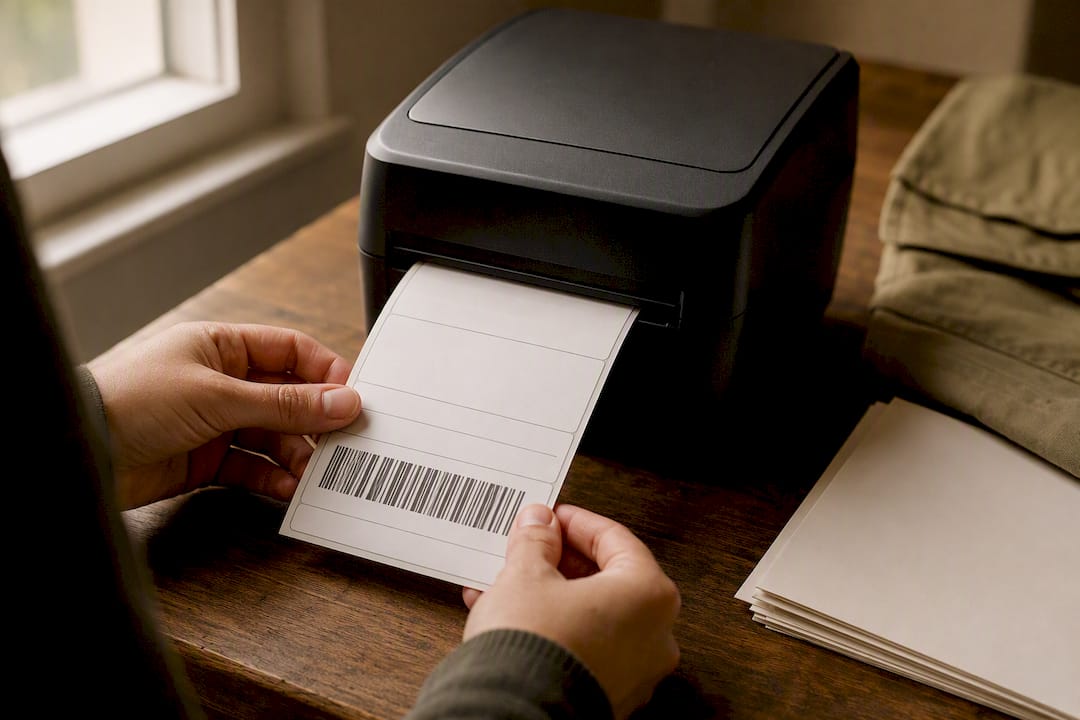
Self-arranged shipping means you buy postage anywhere you want. USPS.com, a local shipping store, or a third-party platform. The catch is Depop requires tracked shipping for any order marked "Other" as the shipping method, and you're responsible for manually entering that tracking number into the app yourself. Miss this step and you lose seller protection if the buyer disputes delivery.
Here's roughly what sellers report paying for Depop's integrated USPS labels by weight, compared to typical commercial rates from a service like Pirateship:
| Weight Tier | Approx. Depop Label Cost | Approx. Commercial Rate |
|---|---|---|
| Under 4 oz (jewelry, small accessories) | $4 to $5 | $3 to $4 |
| 4–8 oz (t-shirts, light tops) | $6 to $7 | $4 to $5 |
| 8 oz–1 lb (jeans, light jackets) | $7 to $9 | $6 to $7 |
| 1–2 lb (sweaters, boots) | $10 to $13 | $7 to $10 |
| 2–5 lb (coats, multi-item bundles) | $13 to $17 | $9 to $13 |
These figures come from seller-collected data and a 2026 breakdown of Depop/USPS shipping tiers, not a fixed rate card Depop publishes, so treat them as planning ranges rather than exact quotes. Actual commercial rates also shift by shipping zone and package density, something the Bureau of Transportation Statistics notes applies to freight pricing broadly, not just USPS. Weigh your item with packaging included before you commit to a price. A shirt that feels "light" but comes in at 9 ounces instead of 7 can bump you into the next tier and quietly erase your profit.
Who Pays Shipping: Buyer-Paid vs. Free Shipping Math
Depop lets you set shipping as either a flat fee the buyer pays at checkout or "free," which really just means you've folded the cost into the item price. Buyers see this distinction clearly on the listing page, and it affects click-through behavior. Listings marked free shipping tend to convert better because buyers dislike surprise costs at checkout, even when the total price is identical.
But free shipping isn't free. It's deferred, and it still runs through the same fee stack described earlier.
- Buyer pays shipping: the shipping charge gets added to the transaction total, and Stripe's 3.3% + $0.45 applies to that larger number. You break even more cleanly since postage is a pass-through cost.
- Seller offers free shipping: you set a higher item price to cover postage, but now the processing fee is calculated on a number that already includes your shipping buffer, meaning you're paying a fraction of a percent more in fees on the same net revenue.
The practical rule most experienced sellers land on: keep shipping costs within about a quarter of the item's sale price when charging separately. Above that, buyers balk at checkout. If you're going the free-shipping route instead, bake in a minimum $5 buffer for anything under two pounds, based on typical packaging and postage cost patterns.
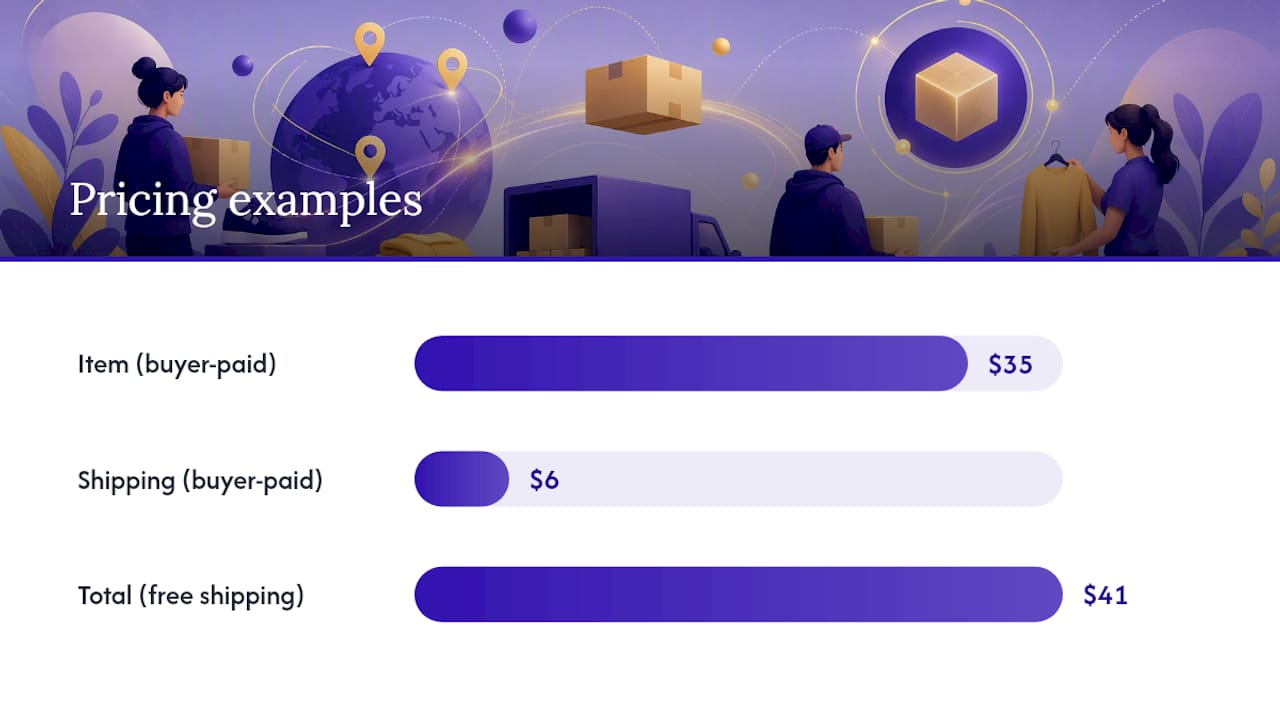
Pro Tip: Test both formats on similar items in your closet. If a $35 hoodie with $6 shipping sells slower than a $41 hoodie with free shipping, that's real data about your specific buyers, not a general rule to apply everywhere.
A Worked Example: Fees and Payout on a $50 Depop Sale
Numbers settle arguments faster than opinions, so here's the full math on a $50 item shipped with a $7 charge.
- Gross transaction total: $50.00 item + $7.00 shipping = $57.00
- Depop selling fee: $0.00 (US sellers don't pay a separate marketplace fee)
- Payment processing fee (3.3% + $0.45): $57.00 × 0.033 = $1.88, plus $0.45 = $2.33
- Depop shipping label cost (1–2 lb tier): approximately $11.00
- Packaging (poly mailer): approximately $0.20
- Net payout: $57.00 − $2.33 − $11.00 − $0.20 = $43.47
That's on a $50 sale where the buyer covered shipping directly. Now flip it to Variant B: you list the same item at $54 with "free shipping" instead. The processing fee rises slightly to $2.23 on the $54 total, but you've absorbed the $11 label cost into your price. Net payout lands close to $40.57 once the same packaging cost is subtracted, meaning the buyer-pays version actually nets you more here.
Swap that Depop label for a commercial-rate label around $8 instead of $11, and you claw back roughly $3 per shipment. Run 40 sales a month at that difference and you've recovered $120 that used to disappear into label markup.
Practical Tactics to Cut Depop Shipping Costs Today
Small operational changes compound fast once you're shipping dozens of items a month.
Switch to commercial-rate labels. Services like Pirateship give access to USPS commercial and Ground Advantage pricing without a monthly fee, and sellers commonly report savings of 20 to 35 percent per label compared to Depop's built-in pricing, according to ShippingLabel's cost comparison. This move is worth the extra five minutes per shipment once you're consistently moving more than a handful of items weekly. Below that volume, the convenience of one-tap Depop labels may outweigh the savings.
Get packaging right. Poly mailers run roughly $0.12 to $0.25 each, while padded or bubble mailers run $0.40 to $1.20. Choosing the smallest mailer that safely fits the item, rather than defaulting to a bigger bag "just in case," keeps you inside your intended weight tier and avoids surprise upcharges.
- Weigh packaged items on a kitchen scale before listing, not after a sale.
- Batch-print labels once or twice a week instead of one at a time.
- Save shipping presets for your most common item types (tops, bottoms, shoes) to speed up listing.
- Use flat-rate boxes only when an item's actual weight would otherwise push it into a much higher variable tier.
Pro Tip: Keep a small kitchen scale next to your listing station. Guessing weight is the fastest way to underprice shipping and eat your own margin without realizing it until the label prints higher than expected.
Shipping Timelines, Tracking, and Seller Protection Rules
Depop expects sellers to ship within a few business days of a sale. Miss that window and buyers can request a refund, and Depop can cancel the order automatically. Tracking is not optional for protection purposes: if you use a Depop-generated label, tracking syncs to the order automatically the moment you print it.
If you're shipping "Other" (a self-arranged label), you must manually enter tracking into the app yourself. Fail to add it within about 10 days and the order can be auto-canceled and refunded, no dispute required on the buyer's part.
- Ship fast, and your seller rating benefits directly.
- Untracked shipments leave you with zero protection in a "never arrived" dispute.
- Automatic cancellations hurt your account standing even when the delay wasn't really your fault.
Treat the tracking step as non-negotiable, not a nice-to-have you'll get to later.
International Shipping Basics for Depop Sellers
International orders bring real upside (a bigger buyer pool) and real friction (customs, cost, delays). Depop-generated labels sometimes include customs forms automatically depending on destination, but for many countries you'll need to prepare a customs declaration yourself before the package ships.
Expect international postage to run noticeably higher than domestic, often two to three times the domestic rate depending on destination and weight, with delivery timeframes stretching from one to several weeks rather than days. That gap in speed and cost is the biggest source of buyer complaints on cross-border sales.
- List clear, honest handling-time estimates on international-friendly listings.
- Message buyers proactively if customs delays a shipment past the quoted window.
- Factor customs and extended transit time into your price before accepting the order, not after.
Running Your Shipping Math With Resell Ready
Manual math works until you're listing dozens of items a week and start losing track of which SKUs are actually profitable after shipping. Resell Ready's Vintage Clothing Margin Calculator is built for exactly this problem in resale categories where weight and packaging swing margin more than people expect.
The workflow is simple: weigh and measure the item, pick your packaging, choose your label path (Depop or commercial-rate), then run those numbers through the calculator alongside Depop's fees and your target margin before you set a listing price.
- Minimum inputs: item cost, postage, packaging, Depop fees, payment processing, target margin.
- Real-time ROI tracking flags a bad-margin item before you list it, not after the sale posts.
- A verified supplier database helps you avoid repeating sourcing mistakes that compound the same shipping-fee errors month after month.
| Point | Details |
|---|---|
| Weigh before pricing | Package weight determines your label tier, so guessing costs you real margin. |
| Two label paths exist | Depop labels are convenient; commercial-rate labels often save 20–35% per shipment. |
| Processing fee applies to total | Stripe's 3.3% + $0.45 hits item price plus shipping combined, not just the item. |
| Buffer free-shipping listings | Bake in at least a $5 shipping cushion when advertising free shipping. |
| Tracking protects you | Untracked "Other" shipments carry zero seller protection in a dispute. |
What the Numbers Actually Tell Depop Sellers
Most shipping advice online treats Depop's label price as fixed and unavoidable, which is where a lot of new sellers give up margin without realizing it. It isn't fixed. It's a default, and defaults exist for people who value convenience over five extra minutes of comparison shopping on postage.
The conventional wisdom says "just use free shipping, it converts better," and that's true as far as it goes. What gets skipped is the second half of that sentence: free shipping only protects your margin if you've actually calculated what it costs you first. A $5 buffer isn't a suggestion, it's the difference between a sale that pays you and one that quietly pays your buyer's shipping instead.
If I had to pick the one habit that separates sellers who scale from sellers who plateau at a side hustle, it's treating shipping as a line item to calculate, not a fee to absorb and forget. Weigh the item. Check the tier. Run the math before the price goes live. Everything else in this article is detail sitting on top of that one decision.
— Christian
Sources
- Seller fees and charges – Depop Help Centre
- Depop Shipping Guide: Prices, Fees & How to Save | ShippingLabel
- Depop Shipping Fees & Costs Explained – CLOSO