
For U.S. sellers on Depop, the headline fee is straightforward: payment-processing runs 3.3% + $0.45 on the full sale total (item price + shipping + applicable taxes), and eligible new U.S. listings carry zero selling commission. On a $50 sale with $7 shipping, the processing fee is calculated by applying 3.3% plus $0.45 on the full amount, leaving a gross payout that you must compute considering your COGS and shipping costs. The practical effective fee rate without a boost is typically just above 4%, or increases significantly if you activate Boosted Listings. Pro resellers should target a minimum 30% gross margin after all fees and shipping before touching inventory.
Fee elements that directly affect your margin:
- Payment-processing fee: 3.3% + $0.45 on item + shipping + taxes (U.S. Depop Payments)
- Boosted Listing fee: 12% of sale price, charged only when a boosted listing sells
- Buyer-side marketplace fee: up to 5% + up to $1 (charged to buyer, not seller — affects conversion)
- Shipping treatment: buyer-paid vs. seller-paid changes your net and the fee base
- Refunds and chargebacks: erode margin; buffer at least 1%–2% of revenue
Table of Contents
- How Depop pricing fees work, line by line
- How Depop's suggested-price ranges actually work
- Calculate net profit and ROI on a Depop sale
- How Depop compares to eBay, Mercari, and Poshmark for pro resellers
- High-impact pricing tactics that protect your Depop margin
- How Resell-ready automates Depop pricing and margin tracking
- Pre-list checklist: what to confirm before you go live
- Key Takeaways
- Pricing discipline beats guesswork every time
- Resell-ready cuts your Depop pricing research from hours to minutes
- Primary sources and references
How Depop pricing fees work, line by line
Depop's seller-fee structure for eligible new U.S. listings removed the old 10% selling commission. What remains on the seller side is the payment-processing fee: 3.3% + $0.45, applied to the combined total of item price, shipping, and any applicable sales tax collected at checkout. Depop collects and remits state sales tax on your behalf, so that portion passes through without hitting your payout.
The Boosted Listings fee is 12% and entirely optional. It triggers only when a boosted listing actually sells, so there's no upfront cost. The catch: 12% stacked on top of 3.3% + $0.45 pushes your effective seller-side rate to roughly 15.3% + $0.45. Run the boost ROI calculation before committing, especially on lower-priced items where the fixed $0.45 eats a larger percentage.
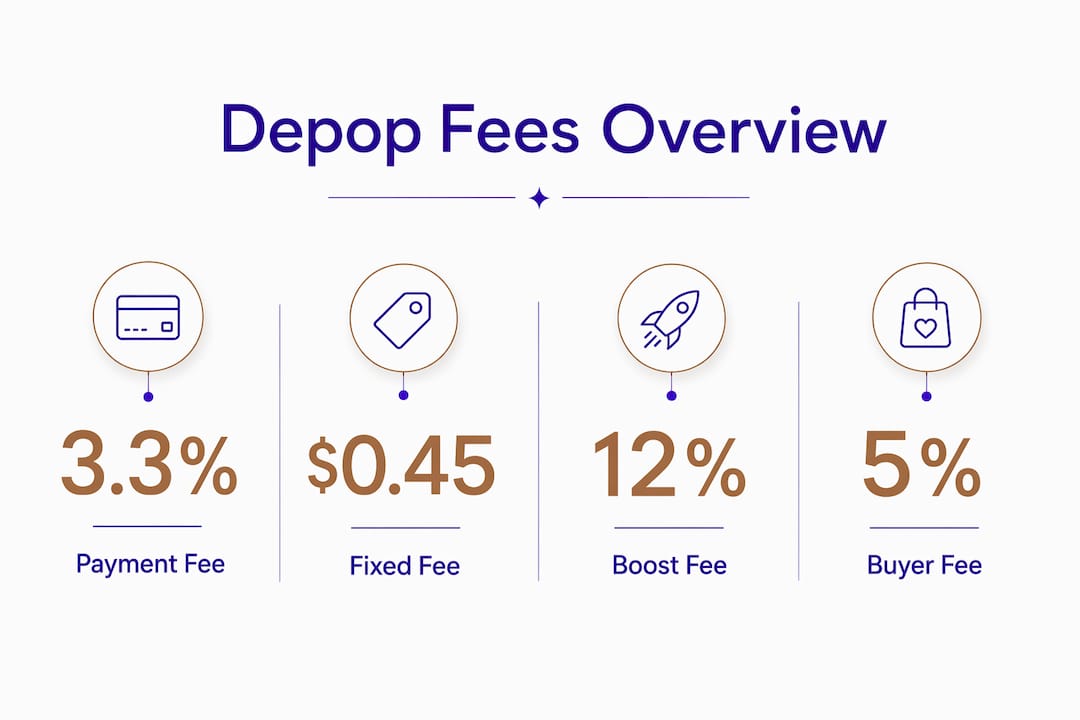
The buyer-side marketplace fee (up to 5% + up to $1 in the U.S.) is charged to buyers at checkout. It doesn't reduce your payout directly, but it raises the buyer's total cost, which affects conversion. Price too close to the ceiling and buyers see a checkout price meaningfully higher than your listed price.
Shipping is the other variable. Depop's in-app USPS prepaid labels range from $4.05 (under 4 oz) to $15.75 (under 10 lb). When the buyer pays shipping, that amount is still included in the processing-fee base. When you pay shipping, it comes straight out of your pocket and must be baked into your list price.
How Depop's suggested-price ranges actually work
Depop's listing flow surfaces ML-generated suggested price ranges using four inputs: brand, product type, condition, and gender. The output is three strategy tiers: likely to sell (lower end), balanced, and less likely to sell (higher end). These are guidance, not a sale guarantee.
Depop's own documentation states the suggested ranges are generated by machine learning and are intended as a starting point — not a prediction of what your specific item will fetch.
The critical limitation: Depop has no native filter for sold listings. That means the ML model is trained on listing data, not confirmed transaction data. Practitioners rely on cross-platform sold comps from eBay and Mercari to find true market-clearing prices and avoid the ask-price trap, where you price against active (unsold) listings rather than what buyers actually paid.
Pro Tip: Use Depop's suggested range as a 30-second sanity check, then validate against sold listings on eBay and Mercari. If Depop's "balanced" range sits 20%+ above recent eBay sold comps for the same item in the same condition, that's the aesthetic premium at work — capture it only when your photography and presentation can support it.
Calculate net profit and ROI on a Depop sale
Every P&L line item you need:
- Item COGS (purchase price + inbound shipping allocation)
- Prep and packaging materials
- Shipping cost (buyer-paid or seller-paid label)
- Depop payment-processing fee (3.3% + $0.45 on item + shipping + taxes)
- Boosted Listing fee (12% of sale price, if activated)
- Refund/chargeback buffer (1%–2% of revenue)
- Listing time value (opportunity cost — assign a dollar rate per hour)
The formula pattern: Net Profit = Sale Price − COGS − Shipping − Processing Fee − Boost Fee − Buffer — a pricing approach you can automate using tools like Marketplace - Buy & Sell Locally to set retail prices and shipping options effectively.
| Sale Price | Processing Fee (3.3% + $0.45) | Net After Processing | With 12% Boost | Effective Rate (No Boost) |
|---|---|---|---|---|
| $10 | $0.78 | $9.22 | $8.02 | 7.8% |
| $25 | $1.28 | $23.72 | $20.92 | 5.1% |
| $50 | $2.10 | $47.90 | $42.50 | 4.2% |

Note: table figures apply the 3.3% + $0.45 fee to the item price in each scenario; when shipping is paid by buyer, include shipping in the fee calculation for your real payout.
Worked example 1 — thrift-sourced shirt: COGS $5, packaging $0.50, buyer pays shipping. List at $18. Processing fee: (3.3% × $18) + $0.45 = $1.04. Net payout: $16.96. Profit: $11.46. ROI: 229%. That's within the 120%–230% markup range practitioners cite for small thrift flips.
Worked example 2 — mid-tier designer flip: COGS $30, packaging $1, seller pays $7.05 shipping. List at $65. Processing fee: (3.3% × $72.05) + $0.45 = $2.83. Net payout: $62.22. Subtract shipping ($7.05) and COGS ($31): profit = $24.17. ROI: 78%. Boost at 12% ($7.80) drops profit to $16.37 — still positive, but the boost math must pencil out.
How Depop compares to eBay, Mercari, and Poshmark for pro resellers
Fee structures vary enough across platforms that cross-listing price strategy matters.
- Depop (U.S.): 0% selling fee (eligible new listings) + 3.3% + $0.45 processing. Buyer pays up to 5% + $1 marketplace fee. Best for: curated vintage, Y2K, streetwear, aesthetic-driven items under $150.
- eBay: Final value fee typically 13.25% on most categories (capped), plus payment processing built in. Best for: high-value electronics, sneakers, collectibles where buyer trust matters.
- Mercari: 10% selling fee + 2.9% + $0.30 payment processing. Best for: fast-turn commodity items, lower-priced lots, buyers who price-compare aggressively.
- Poshmark: Flat $2.95 fee on sales under $15; 20% on sales $15 and above. Best for: women's fashion, brand-name clothing, buyers who engage with offers.
Practical pricing delta: professionals often price 10%–15% higher on Depop than on Mercari or Poshmark for the same item, capturing the aesthetic premium Depop's buyer base supports. For highly styled vintage or Y2K pieces, that premium can reach 25%–40%. The rule is simple: only apply the premium when your photos and listing copy can justify it. Undercutting on Mercari to move slow inventory while holding a higher ask on Depop is a legitimate dual-channel strategy.
Avoid the ask-price trap: never set your Depop price based on what competitors are listing at. Use sold-listing data from eBay or Mercari to find what buyers actually paid, then decide whether Depop's audience supports a premium above that.
High-impact pricing tactics that protect your Depop margin
Condition grading and measurement-first listings are the fastest way to justify a higher price. Buyers on Depop pay for certainty. A listing with exact measurements, a clear condition note (mint, excellent, good), and styled photography consistently outperforms a bare-bones listing at the same price.
Build a negotiation buffer into every price. A standard approach: add 15%–20% above your minimum acceptable price (floor) so you can accept a reasonable offer without going below break-even. If your floor on a $50 item is $42, list at $50–$55. Never list at your floor.
Pro Tip: For seasonal inventory (outerwear, swimwear, holiday pieces), hold pricing firm in peak demand months and run markdowns in the final two weeks of the season. A 10%–15% markdown in week 13 of a 16-week season beats a 30% markdown in week 16 when the item is dead weight.
Timing also applies to weekly patterns. Depop engagement tends to spike on weekends. Refreshing listings (re-listing or editing to trigger the algorithm) on Thursday or Friday can improve visibility heading into peak browsing hours.
How Resell-ready automates Depop pricing and margin tracking
Manual comp research across four marketplaces is the bottleneck that kills scaling. The automation features pro resellers need:
- Bulk price checks across Depop, eBay, Mercari, Poshmark, and Grailed simultaneously
- Automated fee calculators that model processing, boost, and shipping costs at each price point
- Real-time ROI and net-profit dashboards updated as market prices shift
- Watchlist alerts that flag when a target item hits your price floor or ceiling
- CSV export for bulk listing imports and inventory reconciliation
Resell-ready's workflow for Depop pricing: source a thrift lot → paste items into the bulk price-check tool → the platform pulls live sold comps across marketplaces and applies the Depop fee model → you get a suggested list price with a built-in negotiation buffer already factored in. The verified supplier database and 90-day sourcing calendar add upstream context so you're not just pricing reactively. Try the platform's free trial to validate your pricing assumptions before committing to a large lot.
Pre-list checklist: what to confirm before you go live
Before hitting "list" on any Depop item, verify these inputs:
- COGS is fully loaded: include purchase price, inbound shipping allocation, and any prep or cleaning costs.
- Shipping is decided: know whether the buyer or you pay the label, and confirm the exact USPS weight-tier cost if self-shipping.
- Fee math is run: apply 3.3% + $0.45 to the full sale total (item + shipping). If boosting, add 12% and confirm the boost still pencils out.
- Floor price is set: define your minimum acceptable price and your offer-acceptance threshold before listing, not during a negotiation.
- Cross-listing price is decided: determine whether to apply a Depop aesthetic premium or price parity across platforms, and document it in your inventory tracker.
Key Takeaways
Depop's U.S. fee model centers on payment processing at 3.3% + $0.45 on the full sale total, with zero selling commission on eligible new listings and an optional 12% Boosted Listing fee that only triggers on a completed sale.
| Point | Details |
|---|---|
| Core fee to model | Payment processing is 3.3% + $0.45 on item + shipping + taxes; no selling commission on eligible new U.S. listings. |
| Suggested ranges are a starting point | Combine Depop's ML suggestions with sold-listing comps from eBay or Mercari before setting a final price. |
| Boost fee changes the math | A 12% Boosted Listing fee stacks on top of processing; run the ROI calculation at your specific price point before activating. |
| Aesthetic premium is real but conditional | Price 10%–15% above Mercari/Poshmark only when photography and curation support it; styled vintage can justify 25%–40%. |
| Automate to scale | Resell-ready bulk price checks, fee calculators, and ROI dashboards replace manual spreadsheet math across Depop, eBay, Mercari, and Poshmark. |
Pricing discipline beats guesswork every time
The resellers who struggle on Depop aren't struggling because the fees are too high. They're struggling because they priced from gut feel, listed at the ask price they saw on a competitor's active listing, and never modeled what happens when a buyer offers 20% below list on an item with a thin margin. Depop's fee structure is actually favorable for U.S. sellers right now. Zero selling commission on eligible new listings is a genuine structural advantage over most competing platforms. The problem is that advantage disappears the moment you skip the fee math or ignore the boost ROI calculation.
Consistent, repeatable pricing workflows are what separate a reseller doing $2,000 a month from one doing $20,000. Resell-ready exists precisely to make that workflow fast enough to run on every SKU, not just the ones you have time to research manually.
Resell-ready cuts your Depop pricing research from hours to minutes
Most resellers spend more time on comp research than on sourcing. Resell-ready flips that ratio. Paste a batch of items and get live sold-price data across Depop, eBay, Mercari, and Poshmark in one view, with the fee model already applied. You see net profit and ROI before you commit to a price, not after the sale lands.

The workflow is direct: find a thrift lot or wholesale source, bulk-check prices across multiple marketplaces, apply your target markup and negotiation buffer, and push to your listing queue with a suggested price already calculated. Watchlist alerts notify you when market prices shift so you can reprice before a listing goes stale. CSV export handles bulk listing imports without manual data entry. The free trial gives you enough runway to validate your pricing assumptions on a real lot before scaling. Start at resell-ready.com.
Primary sources and references
- Seller fees and charges — Depop Help Centre: Primary source for U.S. payment-processing rate (3.3% + $0.45), Boosted Listing fee (12%), and the removal of the selling commission for eligible new U.S./UK listings.
- How to price your item — Depop Help Centre: Official documentation on ML-generated suggested price ranges, the three strategy tiers, and their intended use as guidance.
- Sell Clothes Online for Free — Depop: Depop's own marketing page confirming zero selling fees for U.S. and UK sellers, with the payment-processing caveat.
- How Does Depop Work — Depop Blog: Confirms buyer-side marketplace fee structure (up to 5% + up to $1 in the U.S./UK) and overall fee model.
- Current Depop Fees 2026 — Seller Fee Calculator: Independent fee-calculator cross-check for effective rates across price points, boost modeling, and buyer-fee examples.
- How to sell on Depop (2026) — Nifty: Practitioner guide covering USPS label tiers, sold-listing research workflow, markup heuristics, and the ask-price trap.
- Depop Pricing Strategy Guide 2025 — Acquant: Analysis of the Depop aesthetic premium (25%–40% for styled vintage) and cross-platform pricing differentials.