
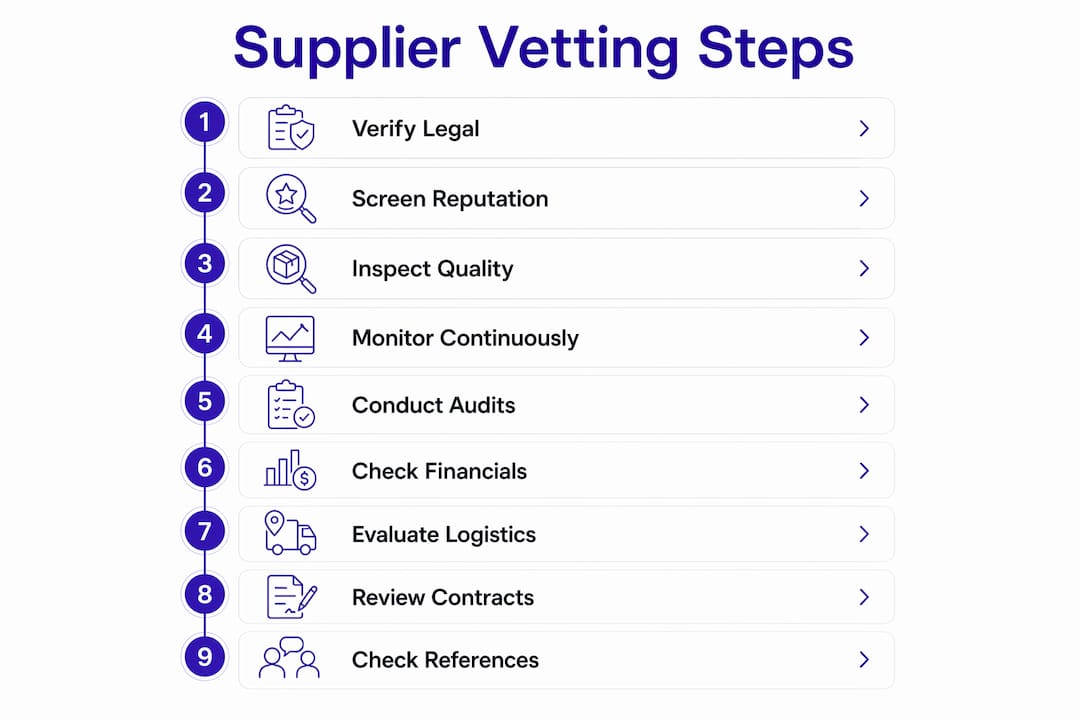
A solid supplier vetting checklist starts with three non-negotiables: confirmed legal identity, clean sanctions screening, and a trial order before you commit real capital. Get those three right and you've eliminated the majority of fraud and quality failures that derail FBA businesses. Miss any one of them and you're building on sand.
Here's what a complete vendor assessment checklist covers for US-based wholesale sourcing:
- Legal entity and beneficial ownership verification aligned with the US Corporate Transparency Act and Know Your Supplier (KYS) standards
- Sanctions and watchlist screening covering the supplier entity, owners, directors, and officers via OFAC and related databases
- Pre-mass production inspection or trial order to confirm quality, packaging, and specs before scaling
- Continuous monitoring with risk-weighted scoring so you focus due diligence where disruption would hurt most
- Insurance, W-9, and banking detail verification to prevent wire fraud and stay IRS-compliant before the first payment clears
Each of these feeds into the sections below. Work through them in order the first time; after that, the monitoring layer keeps running in the background.
Table of Contents
- 1. Verify supplier legal ownership and regulatory compliance
- 2. Screen for reputational and adverse media risks
- 3. Confirm product quality through pre-mass production inspections
- 4. Build a continuous monitoring and risk-weighted scoring system
- 5. Use physical audits and local third-party inspections
- 6. How Resell-ready supports the supplier vetting process
- 7. Assess supplier financial stability and order capacity
- 8. Evaluate logistics capabilities and shipping reliability
- 9. Review contract terms and wholesale sourcing negotiation points
- 10. Red flags from references and previous business partners
- Resell-ready gives you a verified starting point
- Key Takeaways
1. Verify supplier legal ownership and regulatory compliance
The first step in any supplier verification process is confirming the business actually exists in the form it claims. Collect the legal entity name, state of incorporation, EIN, registered address, and the name of at least one officer. Then run those against the Secretary of State business search for the state of formation. If the entity is administratively dissolved or has an expired registered agent, that search will tell you before you sign anything.
KYS protocols require verifying beneficial ownership for any individual or entity holding a significant stake in the supplier, in line with anti-money laundering requirements under the US Corporate Transparency Act. In practice, that means collecting ownership data for anyone holding 25% or more, and checking whether any of those individuals are politically exposed persons (PEPs).
Key documents to collect:
- Articles of incorporation and EIN confirmation
- State business registration in good standing
- Sector-specific licenses (import, manufacturing, export)
- W-9 (or W-8BEN-E for international suppliers)
- Certificate of insurance naming your entity as additional insured
Sanctions and watchlist screening must cover the entity itself plus every named owner, director, and officer. The OFAC SDN List search at sanctionssearch.ofac.treas.gov is free and required for US businesses. OpenSanctions adds broader international coverage.
Pro Tip: Before wiring any payment, confirm the bank account beneficiary matches the legal entity name on the business license exactly. Mid-relationship payment changes sent by email are one of the most common wire fraud vectors in cross-border trade. Reconfirm through a known phone contact, not the email thread.
2. Screen for reputational and adverse media risks
Reputational screening is where most FBA sellers cut corners, and it's where supply chain surprises tend to originate. Adverse media checks should cover litigation, enforcement actions, and regulatory fines, time-bounded to the past five years to stay relevant without drowning in ancient history.
What to screen for:
- Product safety incidents and recalls
- Regulatory fines or enforcement actions from the FTC, CPSC, or CBP
- Active lawsuits involving product liability or fraud
- Negative press tied to labor violations or environmental breaches
Severity-weight what you find. A single minor fine from three years ago is different from a pattern of CPSC enforcement actions. The goal is to distinguish disqualifying risks from manageable ones, not to build a perfect supplier from scratch.
One thing most sellers miss: reputational screening shouldn't be a one-time onboarding step. Experts stress continuous monitoring because compliance status and financial health can shift fast, especially with overseas manufacturers navigating changing US import regulations.

3. Confirm product quality through pre-mass production inspections
Placing a large order without a trial run is the fastest way to end up with a warehouse full of unsellable inventory. A pre-mass production inspection or trial order is the final quality gate before you scale, covering product specs, packaging, labeling, and supplier communication under real production conditions.
Steps to run a proper pre-production check:
- Request a sample from actual production stock, not a pre-prepared showroom unit
- Verify packaging against your Amazon FBA labeling requirements
- Check that dimensions, materials, and finishes match the approved spec sheet
- Test communication responsiveness during the sample phase — slow replies now mean slow replies during a problem
For retail products, packaging standards matter as much as the product itself. A supplier who can't hit your packaging spec consistently will generate FBA returns and negative reviews.
Pro Tip: Virtual factory tours work well for initial screening, but they can't replace an on-site audit for high-volume commitments. A video walkthrough confirms the facility exists; a physical visit confirms it can actually produce at your required volume and quality level.
4. Build a continuous monitoring and risk-weighted scoring system
Most sellers treat supplier vetting as a one-time onboarding task. That's a mistake. Continuous supplier monitoring includes automated re-screening against updated sanctions lists, ownership changes, financial distress signals, and adverse media — and the frequency should vary by supplier tier.
Risk-weighted scoring systems rank suppliers by the disruption impact they'd cause if they failed. A Tier-1 supplier producing your top-selling ASIN gets weekly monitoring. A Tier-3 supplier for a low-volume SKU gets quarterly review. That's not laziness — it's where the resource math actually works.
Monitoring data sources to track:
- OFAC and sanctions list updates (weekly for Tier-1)
- Ownership and director changes via Secretary of State filings
- Financial distress signals: late payments, credit downgrades, court filings
- Adverse media alerts via Google News or a dedicated monitoring tool
- Compliance status for import certifications and product safety standards
Using risk-weighted scoring focuses compliance effort on the suppliers whose failure would actually hurt your business, rather than spreading thin attention across every vendor equally.
5. Use physical audits and local third-party inspections
Desk-based verification has real limits. Physical factory visits uncover realities like undisclosed subcontracting, overstated capacity, and equipment that exists on paper but not on the floor. A supplier presenting as a manufacturer may be a trading company routing orders through a third party — a distinction that affects price, quality control, and your ability to enforce specs.
Local third-party auditors are the practical solution when you can't travel. They arrive at the registered address, confirm the company name matches the business license, walk the production floor, count major equipment, and deliver a report within 48 hours.
Audit focus areas:
- Workforce headcount and skill level relative to claimed capacity
- Equipment condition and production line layout
- Certification validity checked against originals on-site
- Subcontracting disclosure and supply chain transparency
- Quality control checkpoints: incoming materials, in-process, final inspection
The cost of a third-party audit is a fraction of a bad order. For any supplier representing more than 20% of your sourcing volume, it's not optional.
6. How Resell-ready supports the supplier vetting process
Resell-ready is built specifically for professional FBA sellers who need supplier verification and margin analysis in one place, not spread across five spreadsheets and three browser tabs.
| Vetting Task | Manual Process | Resell-ready Workflow |
|---|---|---|
| Supplier discovery | Search Alibaba, cross-reference manually | Verified supplier database across Alibaba, Made-in-China, Global Sources, 1688 |
| Price verification | Check eBay, Poshmark, Mercari separately | Live resale price checks across 6 platforms simultaneously |
| Margin calculation | Manual spreadsheet with frequent errors | Real-time ROI and net profit tracking per ASIN |
| Supplier monitoring | Ad hoc Google searches | Watchlist alerts and price target notifications |
| Inventory tracking | Manual entry, version control issues | Automated P&L and inventory dashboard |
The verified supplier directory removes the first layer of risk by surfacing suppliers who have already passed basic legitimacy checks. From there, the AI-powered buy/skip verdicts and suggested pricing let you move fast on good opportunities without second-guessing the numbers.
7. Assess supplier financial stability and order capacity
A supplier who can handle a trial order of modest size may not be able to scale to much larger volumes without cash flow problems or production delays. Request at least two years of financial summaries, a Dun & Bradstreet Paydex score, or recent bank references before committing to a high-volume relationship.
Watch for concentration risk: if your order represents a significant portion of their annual revenue, they may prioritize you initially but struggle to maintain quality as they scale to meet demand. Ask directly about their largest current customers and typical order volumes. A supplier who hesitates to answer that question is telling you something.
8. Evaluate logistics capabilities and shipping reliability
Shipping reliability directly affects your FBA inventory health score. Ask for documented lead times across at least three recent orders, not the sales team's best-case estimate. Confirm whether the supplier handles export documentation in-house or routes through a freight forwarder, and clarify Incoterms before any purchase order is issued.
For US imports, verify that the supplier has experience with CBP entry requirements, ISF filing, and any product-specific import regulations (CPSC, FDA, USDA depending on category). A supplier unfamiliar with US customs processes will create delays that cost you Buy Box position.
9. Review contract terms and wholesale sourcing negotiation points
Before signing, confirm these contract elements in writing: minimum order quantities, lead times with penalty clauses for delays, quality rejection thresholds and remedies, IP ownership for any private label work, and exit terms that don't trap you in a long-term commitment with a failing supplier.
Non-conformance handling is the clause most sellers skip and later regret. Agree in advance on what happens when goods arrive damaged, out of spec, or late. "We'll work it out" is not a contract term.
10. Red flags from references and previous business partners
Call references, don't just collect them. Ask specifically about order accuracy, response time during problems, and whether the supplier ever substituted materials without notice. A supplier who provides three references but all three are reluctant to discuss specifics is a pattern worth noting.
Other red flags that warrant escalation: pressure to pay quickly via unusual methods, mid-negotiation requests to change banking details, very broad product catalogs with no clear manufacturing focus, and lead times that seem implausibly short for the order volume. Any one of these can be explained. Multiple together usually can't.
Resell-ready gives you a verified starting point
Vetting suppliers from scratch on every new product is slow, error-prone, and expensive. Resell-ready cuts that process down by giving you a verified supplier database alongside real-time margin data, so you're not just finding suppliers — you're finding the right ones for the specific ASINs you're sourcing.
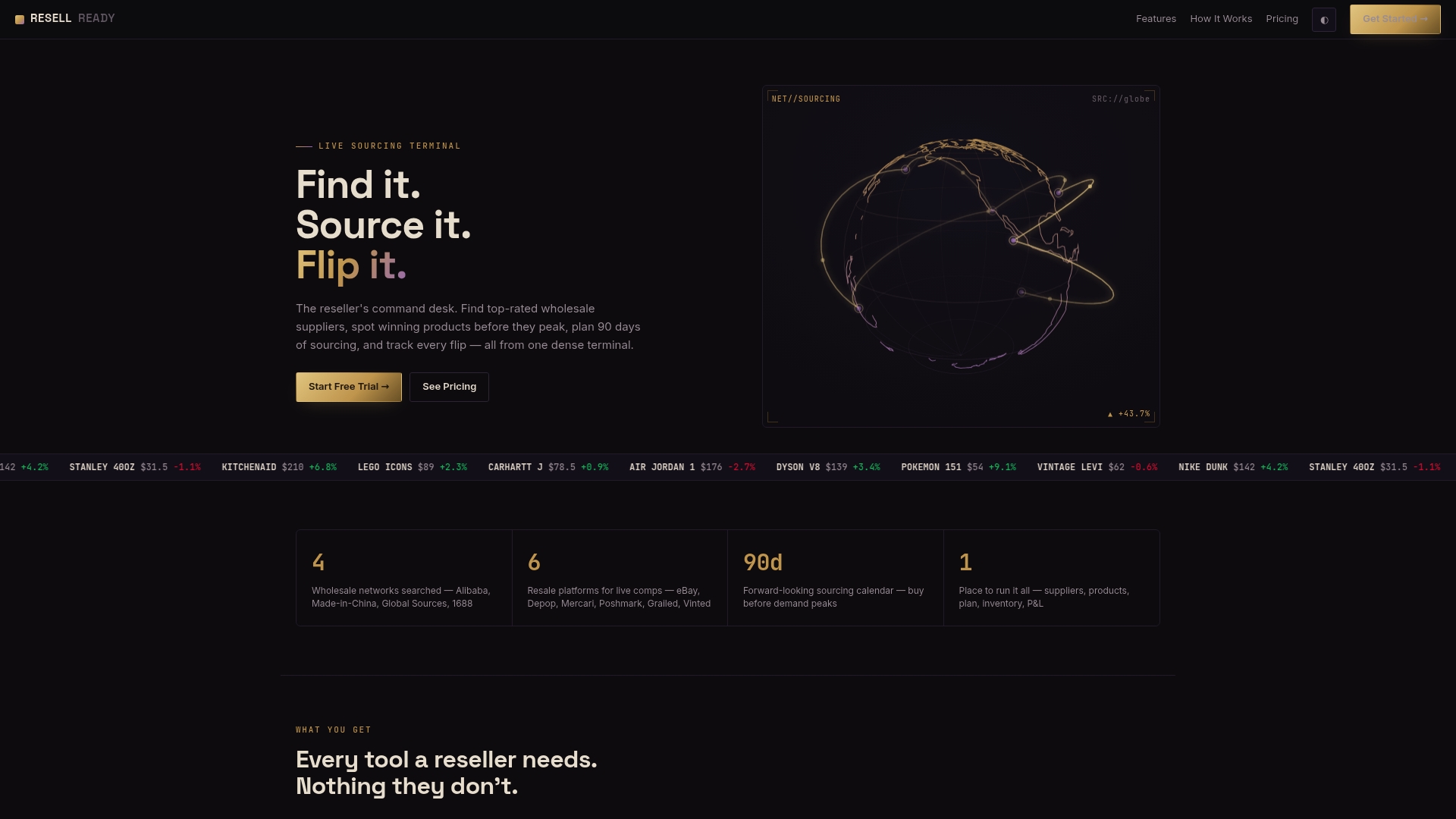
Paste an ASIN, get instant ROI and net profit figures, check live resale prices across eBay, Mercari, Poshmark, and three other platforms, and pull from a directory of pre-screened wholesale suppliers — all from one dark-mode terminal built for speed. The 90-day sourcing calendar and watchlist alerts mean your monitoring layer runs automatically, not manually. Start your free trial at resell-ready.com and run your first supplier check today.
Key Takeaways
A complete supplier vetting process requires legal verification, reputational screening, quality inspection, and continuous risk monitoring — skipping any layer leaves your FBA business exposed.
| Point | Details |
|---|---|
| Legal verification first | Confirm entity registration, beneficial ownership ≥25%, and OFAC sanctions status before any payment. |
| Trial orders before scale | Run a pre-mass production inspection on actual production stock to catch quality and packaging failures early. |
| Risk-weighted monitoring | Score suppliers by disruption impact and monitor Tier-1 suppliers weekly, not just at onboarding. |
| Physical audits close gaps | Third-party on-site inspections reveal subcontracting and capacity issues that desk research cannot. |
| Resell-ready accelerates vetting | The verified supplier database and real-time margin tools replace manual spreadsheet research for FBA sourcing. |